Canadian Shakespeare News


The Death of a Chief Featured by CASP

Author: Sorouja Moll
Date: Mon, 31 Jul 2006 13:33:41 EST

Yvette Nolan and co-adapter/co-director Kennedy Cathy MacKinnon’s Shakespearean adaptation The Death of a Chief rebuilds and restructures the historic tragedy of Julius Caesar to address Aboriginal issues concerning politics, gender, class, race, and nation. On Saturday, February 18, 2006, the adaptation’s fourth workshop was performed by Native Earth Performing Arts at FOOT 2006 – The Festival of Original Theatre “Performing Adaptations” at the Robert Gill Theatre (University of Toronto). For Nolan, it’s all about the process, a process in understanding the complexities of community, ambition, power, betrayal and the lives of Native people in Canada today ; a process of theatre reworking historic and present day political systems to make leaders more accountable to the people.The Canadian Adaptations of Shakespeare Project’s (CASP) webpage for The Death of a Chief offers links to additional resources and information. For the essay concerning The Death of Chief, as well as access to two versions of the workshops’ scripts and a comparative study to Shakespeare’s Julius Caesar, please visit the CASP Online Anthology.  For an interview with director/playwright Yvette Nolan, where Nolan discusses her work on The Death of a Chief, political structures, and the process of adaptation, please visit
CASP’s Interview.

The CASP Multimedia page about The Death of a Chief includes a 17-image slide show, as well as the conference program from the 2006 workshop.  The CASP Spotlight page features a spotlight on Canadian Aboriginal Adaptations of Shakespeare where information concerning aboriginal adaptations of Shakespeare and aboriginal-themed adaptations are featured, as well as several additional links to important centres devoted to developing aboriginal theatre, like Native Earth Performing Arts.  The Death of a Chief is scheduled for full production in 2007.

“Native Earth Performing Arts is Canada’s oldest professional Native theatre company. Dedicated to creating and producing Native theatre and dance” (qtd. from Native Earth Performing Arts website). The Canadian Adaptation of Shakespeare Project is grateful to Nina Lee Aquino, Marketing and Development Coordinator, at Native Earth Performing Arts (NEPA) for her assistance in producing the web page for The Death of a Chief.

The Many Faces of Shakespeare By PETER MONAGHAN

http://chronicle.com/weekly/v52/i45/45a00601.htm
From the issue dated July 14, 2006

The Many Faces of Shakespeare By PETER MONAGHAN

Somewhere in Canada, the country’s 501st adaptation of Shakespeare awaits discovery by Daniel Fischlin and his colleagues at the University of Guelph. As the guardian of the Canadian Adaptations of Shakespeare Project (http://www.canadianshakespeares.ca), Mr. Fischlin intends to identify and catalog the country’s endless number of variants on the works of the Bard of Avon. Among his finds so far: an adaptation of Henry V in which the Toronto Maple Leafs lock ice-hockey sticks with the Montreal Canadiens; Peter Skagen’s 1999 Rodeo and Julie-Ed, whose title tells its tale; and ‘Speare: The Literacy Arcade Game, an Internet-based three-dimensional adventure in which players in search of Shakespearean facts and wisdom ride spaceships around a Prosperian galaxy. “It’s a daunting task,” says Mr. Fischlin, a professor of English and theater. In the five years since he began the project, 60 researchers have worked on the collection, which has hard-copy and online components and which takes in not only plays, but any other work that contains direct uses or echoes of Shakespeare. “Adaptations are interesting things to do because it’s taking the cultural capital of Shakespeare and attaching it to your own name,” Mr. Fischlin notes. “There’s a double payoff.” Anything that borrows from the Bard goes into the database. The result has been that a project that he thought would be quickly over has ballooned, and seems nowhere near complete. “We started digging around, and we’ve come up so far with close to 500 plays from pre-Confederation in 1867 to the present,” he says. Mr. Fischlin began the project out of frustration. “As a young professor, I invariably got stuck with large Shakespeare classes,” he says. “You get 300 students looking for some way to make contact with the plays who don’t have any context.” So he looked to Canadian adaptations as a way to engage Canadians. Of 500 plays, songs, films, and other works, a third are by French Canadians, often in local patois, and many are by and about indigenous Canadians. Of the latter, says Mr. Fischlin, “many take place in the context of aboriginal theater as a place where healing occurs, as part of a deep sense of what some of the necessary rituals of healing are.” For example, Hamlet le Malécite, written in French by Yves Sioui Durand, is about the extinction of the Maliseet tribe of New Brunswick and environs. One part of the project is an online compendium of rare adaptations. To date, 40 texts have been stored there, and Mr. Fischlin and his colleagues plan to add another 40.

07/31/2006 04:31 PM Print: The Chronicle: 7/14/2006: The Many Faces of Shakespeare Among Mr. Fischlin’s least favorite adaptations, which he considers profoundly racist but which he nonetheless put on the site for the sake of completeness, is Chief Shaking Spear Rides Again, or The Taming of the Sioux (1975), by Warren Graves. Accompanying each online play is an introductory essay with embedded links to other study materials. Mr. Fischlin has not been able to locate projects similar to the Canadian Adaptations of Shakespeare Project in other countries. “It’s odd,” he says, “because you could easily do one anywhere from South Africa to the United States to Australia, or even in countries where English isn’t the native language, but Shakespeare is the most produced playwright. There’s so much investment in Shakespeare.” Send ideas to short.subjects@chronicle.com http://chronicle.com Section: Short Subjects Volume 52, Issue 45, Page A6 Copyright © 2006 by The Chronicle of Higher Education


The Bard breaks into video games in city professor’s literacy project

Article in the Guelph Mercury

By Thanad Harmarajah
Mercury Staff
GUELPH

Strap on your seatbelts and take a ride on a futuristic space ship to a faraway galaxy on a quest for Shakespeare’s missing knowledge.
A University of Guelph professor has used William Shakespeare’s Romeo and Juliet to create a futuristic storyline in a computer game to interest young minds and improve literacy skills.
“We’ve tried to create a learning environment that’s not in your face that you’re learning,” said Daniel Fischlin, an English and theatre studies professor.
For full article, see mercury_article_21_6_06.pdf


To be or not to be, eh? Canada loves to rewrite Shakespeare

It began with the typical English teacher’s dilemma: students love Shakespeare’s stories, but stumble over the writer’s 500-year-old language.

So University of Guelph professor Daniel Fischlin went looking for adaptations—plays that take classic plays and characters as starting points, but make major changes to update the language and give them new relevance.

He was bowled over by what he found.

“I expected to turn up maybe 50 Canadian adaptations,” he says. “But, there turned out to be more like 500.”

From the 1871 political satire Measure by Measure, or, The Coalition in Secret Session! to 2000’s The King #5 Henry—a hockey version of Henry V performed in a rink—Canada has been adapting Shakespeare’s classic plays for more than 100 years.

And this passion for Shakespeare doesn’t stop in English Canada. Surprisingly, a quarter of all the adaptations he’s found so far are in French.

So just why is Canada mad for adaptations? Partly, Fischlin speculates, it’s the peculiarly Canadian tendancy to “take the mickey out of high culture.”

But whether it’s to poke fun or to celebrate, the number of adaptations Fischlin found was too much material for a book or even a CD-ROM.

With help of the Social Sciences and Humanities Research Council of Canada he has given these adaptations a home on the web: www.canadianshakespeares.ca —a place students and teachers alike can go to seek out everything from Normand Chaurette’s Les reines to a rap version of a Midsummer Night’s Dream

And there’s a touch of irony to all this. When he started his academic career, Fischlin swore he’d avoid doing Shakespeare research. “There’s just so much out there,” he says. “I didn’t think there was a need for any more.”

Now, with the site expanded to include essays, multimedia, and even online educational games, he’s sitting at the centre of the largest Shakespeare website in the world.

To learn more about SSHRC-supported research, visit www.sshrc.ca.

Words / Nombres de mots : 320 

Deadline / Date limite : June 7

Destination : SSHRC News Canada 

Managing Editor / Réviseur responsable : Jennifer McCarthy 

Author / Auteur : Michael MacLean

Photo caption / Légende photo :

Researcher name / Nom du chercheur : Daniel Fischlin

University / Université : Guelph

Program / Programme : SRG

Year Funded / Année financée : 2002, 2005


Canadian Adaptations of Shakespeare Project (CASP)

www.canadianshakespeares.ca

“Shakespeare is a drunken savage with some imagination whose plays please only in London and Canada.”  Voltaire

“Pourquoi Shakespeare?  Parce que ce rendez-vous avec le plus grand poète dramatique nous en revions depuis longtemps. Il nous était devenu nécessaire.” Jean Gascon

“The Québécois people really, really, really, really love Shakespeare.”  Reynald Robinson

“Shakespeare’s not a Black woman; he could not see things from my perspective.”  Djanet Sears

CASP is the first research project of its kind anywhere in the world devoted to the systematic exploration and documentation of the ways in which Shakespeare has been adapted into a national, multicultural theatrical practice. Directed by Prof. Daniel Fischlin, the CASP website features a wealth of learning, teaching, and research tools related to how Shakespeare has been adapted into (and out of) Canadian theatre.  As well as physical archives which document nearly 500 theatrical adaptations of Shakespeare in Canada from pre-Confederation to the present, the CASP website includes an online database, multimedia sections, original interviews and an online anthology of scripts that all help to enliven our research for a broader online audience.  Upcoming developments will include an RSS news feed of original and syndicated Shakespearean news, a virtual learning commons and ‘Speare: The Literacy Arcade Game.


Controversial Shakespeare Portrait Coming to U of G

Will be Focus of Shakespeare — Made in Canada Festival

There is growing evidence that a Canadian man, who happens to be a friend and supporter of U of G, may own the only portrait of William Shakespeare painted while he was alive. That painting is coming to Guelph next year and will be the focus of the region’s Shakespeare — Made in Canada Festival.

Known as the Sanders portrait, the painting is thought to depict the Bard at age 39 and is owned by Ottawa resident Lloyd Sullivan. It’s also the signature image of U of G’s Canadian Adaptations of Shakespeare Project, which is headed by English Prof. Daniel Fischlin and includes the largest and most complete website in the world dedicated to showing the playwright’s cultural influence on Canada. Fischlin’s research team has been working closely with Sullivan on the Canadian side of the portrait’s history.

The Sanders portrait was also the subject of the 2001 book Shakespeare’s Face and is used by the Stratford Festival of Canada.

The painting will be coming to U of G for a special exhibition at the Macdonald Stewart Art Centre from January to May 2007. In celebration, the University, Stratford Festival, Guelph Arts Council and City of Guelph are teaming up to host a series of regional Shakespeare events that will be held for the duration of the exhibit.
The Shakespeare — Made in Canada festival will include theatrical and musical performances, an exhibition, a speakers’ series and educational programs. The festival will be launched locally May 25 with a special Shakespeare-inspired concert by U of G professor (see related story on page ).

The goal of the festival is to create a regional cultural synergy focusing specifically on Canadian interpretations, adaptations and exhibitions of the work of Shakespeare. It will involve local and regional arts and cultural organizations, local businesses, and elementary, secondary and university students and teachers.
“We hope to provide opportunities to increase awareness of our regional cultural excellence and to create a dynamic and appealing program of events that will attract audiences from within and outside of the community,” says Sue Bennett, the University’s special projects manager.

The Sanders portrait is coming to Guelph thanks to Fischlin. He and his research team travelled across the country to schools, libraries and even people’s basements and attics to uncover original Canadian adaptations of Shakespeare. Fischlin contacted Sullivan and obtained the rights to use the image of the controversial Sanders portrait. “We’re delighted that a rare combination of humanities research, community involvement, University initiative and private support (exemplified in Lloyd Sullivan’s contributions to our project) will culminate in a unique series of events and an even more unique museum exhibit hosted at the University” says Fischlin.

Sullivan inherited the painting from his mother in 1972. It’s believed that Shakespeare sat for an ancestor of Sullivan’s, an unknown actor and painter called John Sanders, in 1603. The portrait was held in the family for 400 years, and at one time was stored under Sullivan’s grandmother’s bed. The portrait has been confirmed by six years of painstaking forensic studies to date from around 1600, and it has not been altered since.

Fischlin is working with Sullivan and others to develop a screenplay based on how the painting was discovered and authenticated, and the controversy it ignited around the world.

Before coming to Guelph, the Sanders portrait will be part of “Searching for Shakespeare,” an international exhibit by the National Portrait Gallery in London that will tour North America during the summer and fall of 2007. The Sanders portrait will join the National Portrait Gallery’s famous Chandos painting and four other early “contender” portraits purporting to represent Shakespeare. It is the first time the portraits have been displayed together. The exhibition will also present the results of new technical analysis and research on several of these pictures


Wordsmyth Theatre presents its inaugural production of Shakespeare’s Julius Caesar, adapted for four actors by David Matheson.

April 19th – April 30th, Wednesday – Sunday, 8pm start time, Sunday matinee 2pm.

Equity Showcase Theatre, 651 Dufferin Street.

Tickets: $15 regular / $12 Students, Sunday matinees: Pay What You Can.

Tickets available at the door.

www.wordsmyth.ca

Innovative, imaginative, intense, Julius Caesar is the debut production of Wordsmyth Theatre.  In this fast-paced adaptation of Shakespeare’s classic tragedy, four actors bring an empire in crisis to life.  A war is waged between ambition and conscience; the bonds of loyalty and friendship are tested; and hidden desires and self-deception lead to a fall from grace.  Incorporating theatrical masks and a zest for language, Wordsmyth’s Julius Caesar heralds a fresh voice in Toronto’s vibrant theatre community.

Wordsmyth is an artist run theatre ensemble, believing in the ability of the spoken word to ignite the imagination. The rehearsal process includes an intense study of the text followed by exploration of images through mask.  The ensemble is committed to mounting high quality, professional, sophisticated work that is honest, compelling, and passionate.

Wordsmyth Theatre is composed of York University grads Christine Horne, Josh Jacobson, David Matheson, Andrea Mittler and Craig Stanghetta.  Julius Caesar features Josh Jacobson as Brutus, Craig Stanghetta as Cassius, and Christine Horne as Antony.  David Matheson directs, with Set and Costume Design by Andrea Mittler.


Media Contact

David Matheson

Artistic Director, Wordsmyth Theatre

3-778 Broadview Avenue

Toronto, ON

M4k 2P7

416 465 5123

wordsmyththeatre@yahoo.ca

www.wordsmyth.ca


A Sporting Bard Hits the Books!

FOR IMMEDIATE RELEASE : Wednesday, March 29, 2006

Toronto, ON… To celebrate the launch of Roxanne Reads New and Used Books online bookstore, Roxanne Reads is proud to host the launch of Upstart Crow Publishing (http://www.ucsn.ca) and the publication of their Fringe hit Sports Bard Series on April 23, 2006 – William Shakespeare’s birthday of course.

Sports Bard Series UCSN hosts Jack Falstaff (Stephen Flett), Chris Marlowe (Matt Toner), Ben Jonson (Rob McKee) and roving reporter Raphael Holinshed (Seamus Dudley) will be on hand to talk up the books and bookstore, interview players from the series, along with unconfirmed appearances by Will Shakespeare and Liz Rex herself.

Upstart Crow Publishing is a new Independent Publishing Company with a focus on Canadian adaptations of Shakespeare as well as other drama for middle and secondary schools. Their new enterprise starts with six titles created by Chris Coculuzzi and Matt Toner: Shakespeare’s Rugby Wars, Shakespeare’s World Cup, Shakespeare’s Gladiator Games, Shakespeare’s Comic Olympics, Shakespeare’s NHL (National History League) and a compilation of all the plays in one volume, Shakespeare’s Sports Canon. Combined; the plays contain references and lines from all of Shakespeare’s 38 plays while venturing through rugby and soccer pitches, Roman Ludi, bizarre Olympic events, and Canadian street hockey all with its tongue firmly planted in its cheek. All five adaptations were originally produced to critical and audience acclaim, consecutively at the 2001-2005 Toronto Fringe Festivals.

Roxanne Reads New and Used Books is a new online bookstore owned and operated by Roxanne Deans, a former actor and theatre producer for Red Letter Theatre. She is also a playwright, with successful stagings of her play Wally and co-adapter (along with Chris Coculuzzi) of the 2004 Toronto Fringe hit Cyrano de Bergerac. A love of books and her entrepreneurial spirit are what have driven Roxanne to start the bookstore, seeing an opportunity to share her passion for the written word as well as create new and exciting literary events for booklovers of all ages.

Come join us for a great evening of literature, theatre, drink and merriment. Copies of the plays will be available for purchase at the launch for $10 (28% off), tax included. Laptops will also be on hand, to surf the Roxanne Reads website.

Launch Date: Sunday, April 23, 2006

7:00 – 10:00 pm

Venue: The Cameron House (back space)

408 Queen Street West

Free Admission

Media Contact: Roxanne Deans, 416-694-2572

roxannereads@sympatico.ca

www.roxannereads.com


Searching for Shakespeare

By Lloyd Sullivan

January 13, 2006

The Searching for Shakespeare exhibition tour will open at the National Portrait Gallery in London, England on March 2nd, 2006 and continue to May 29th, 2006. The exhibition will then travel to the Yale Center for British Art at New Haven, Connecticut and continue from June 24th, 2006 to September 17th, 2006. The tour includes the following portraits: (see attached )


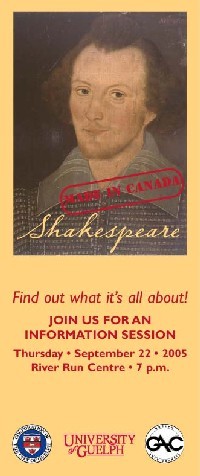
Public Information Meeting September 22 on Guelph’s Shakespeare Festival

Shakespeare in Canada

Thursday September 15, 2005

From: Guelph Arts Council

Find out how you or your organization can be part of Guelph’s upcoming celebration of Shakespeare in Canada.
The University of Guelph, Stratford Festival, Guelph Arts Council and City of Guelph are teaming up to host a major region-wide Shakespeare festival in 2007. They are encouraging the community to get involved in the project, starting by attending a public information session on Thursday, September 22 at the River Run Centre.

The 7 p.m. meeting will include an overview of the vision and mission of Shakespeare Made in Canada, which is being planned for January to May 2007. The festival will feature theatrical and musical performances, an exhibition, a speaker series, educational programs and more. It will also involve local and regional arts and cultural organizations, local businesses, and elementary, secondary and university students and teachers.

The aim is to create a regional cultural synergy focusing specifically on Canadian interpretations, adaptations and exhibitions of the work of Shakespeare.  Under this thematic umbrella, the organizers hope to provide opportunities to increase awareness of this regions’s cultural excellence and to create a dynamic and appealing program of events that will attract audiences from within and outside of the community.

As part of the project, local and regional arts and cultural organizations will be encouraged to showcase their excellence and creativity by developing programming with a Shakespearean theme in 2007. The September 22 information session will provide an opportunity for the community to learn more about the project and to share ideas as to how to become involved.
To RSVP for September 22, please call Sharon Cardow at 824-4120 ext. 52200.

For more information, contact: 
Sally Wismer, Guelph Arts Council Phone: (519) 836-3280 Email: gac@sentex.net