Work on the CASP database updates that have been backlogged continued over the Summer of 2012 with significant new entries now posted and listed below with hyperlinks. Please note that the CASP database will be undergoing a major renovation in early 2013 to address issues with diacriticals causded by Cold Fusion, our current platform. Stay posted for an update once the new platform has been implemented.
Summer 2012 Additions to the CASP DATABASE:
King Lear (2012) by Peter Hinton and August Schellenberg
Hamlet (2012) by Kevin O’Day – National Ballet of Canada
Spring and summer 2012 marked a busy period of research for members of the Canadian Adaptations of Shakespeare Project (CASP) team as they worked on major updates to the online Database. Updates included recent stagings of existing entries, the addition of some secondary sources, tidying up the HTML coding and overall read-ability of the Database, as well as the addition of new leads, which express Canada’s modern take on the work of perhaps the world’s most celebrated playwright, William Shakespeare.
Over sixty new adaptations were added to the Database, ranging from more classical media, (i.e. Peter Hinton and August Schellenberg’s all-Native production of King Lear; Mark Richards’s Hamlet: An Opera; and the National Ballet of Canada’s production of Hamlet) to more contemporary modes of adaptation (i.e. Repercussion Theatre’s DEADLY SIN, Macbeth in Hell: A Cabaret!; Bruce Ramsay’s noir-ish film adaptation of Hamlet; and the innovative graphic novel, Kill Shakespeare¸ by Conor McCreery and Anthony Del Col). Productions such as Vern Thiessen’s Shakespeare’s Will and Rick Miller’s MacHomer have both been restaged consistently since their debuts, and choreographer Alexei Ratmansky has recently re-vamped the National Ballet of Canada’s version of Romeo and Juliet, which is entering its second staging this November. John Mortimer and Edward Atienza’s When That I Was has also been revived in 2008 and 2012 after only two performances in the late 1980s.
Other recent adaptations of note include: the Company of Fool’s hilarious retelling of Henry V, Corinne Jaber and Stephen Landrigan’s production of Love’s Labour’s Lost in Afghanistan, Jean Guy-Legault’s Tout Shakespeare Pour Les Nuls, an epic comedy that summarizes Shakespeare’s 37 plays in one 90 minute performance, and local University of Guelph professor and playwright Judith Thompson’s exploration of the trials and community of homelessness in Hamlet (In Tent City). Considering that the CASP Database’s last major update was in 2005, this summer’s research shows a significant amount of activity in Canada’s literary and theatre communities. It is apparent that Canadians show no sign of tiring of the Bard.
Click on the gallery below to see photos from, among others, BASH’d!, discussed below at some length, the Company of Fools version of Henry V, Bruce Ramsay’s 1940s era family drama version of Hamlet from the Vancouver International Film Festival, and the 2012 all-Aboriginal production of King Lear performed at the National Arts Centre in Otttawa.
This slideshow requires JavaScript.
For audio of Director/Actor/Adaptor Bruce Ramsay discussing his adaptation click below.
One clear trend evident as a result of cataloguing recent adaptations is the shift from the original Shakespearean tongue into a more modern, vernacular style of language, including ample use of slang and references to pop culture. The implications of this new trend are immense, especially in terms of the accessibility of this notoriously difficult literature, expanding across new social, cultural, and political borders. Contemporary adaptors combine present-day cultural and literary practices with the historical texts to create adaptations that are truly unique and, ultimately, Canadian.
There are a few adaptations from the recent updates that illustrate this growing movement. Crad Kilodney, a Toronto-based writer and blogger, has published a series of plays entitled, Shakespeare for White Trash. While the plot and characters remain the same, the language has been dramatically transformed into everyday English. Whereas the opening few lines of Shakespeare’s Hamlet read:
Act I, Scene I. FRANCISCO at his post. Enter to him BERNARDO
BERNARDO: Who’s there?
FRANCISCO: Nay, answer me: stand, and unfold yourself.
BERNARDO: Long live the king!
FRANCISCO: Bernardo?
BERNARDO: He.
FRANSICO: You come most carefully upon your hour.
BERNARDO: ‘Tis now struck twelve; get thee to bed, Francisco.
FRANCISCO: For this relief much thanks: ‘tis bitter cold, ⁄ And I am sick at heart
BERNARDO: Have you have quiet guard?
FRANCISCO: Not a mouse stirring.
BERNARDO: Well, good night. ⁄ If you do meet Horatio and Marcellus, ⁄ The rivals of my watch, bid them make haste.
Hamlet (1.1.1-14)
Kilodney’s adaptation interprets the same scene as follows:
Act 1, Scene 1. Elsinore Castle. FRANCISCO is on guard duty on the watch platform when BERNARDO arrives to relive him.
FRANCISCO: It’s about time, bro. I was supposed to be off at midnight.
BERNARDO: Okay, you can go to bed. Wassup anyway?
FRANCISCO: Not much.
BERNARDO: If you see Horatio and Marcellus, tell them to move their butts. They’re supposed to be on duty, too.
Approaching Shakespeare is a daunting task. The language is complex and full of metaphor and rhetorical and logical play: people simply do not speak like that anymore. Kilodney’s aim is to expand the availability of Shakespeare’s work by making the language easier to understand and more relatable to the general public (Kilodney 2010) In this sense, because Shakespeare’s plays are adapted using more currently commonplace language, their entertainment and moral values are no longer limited to highly-educated Shakespeare connoisseurs. Currently, Kilodney has adapted twenty-nine of Shakespeare’s thirty-eight plays, all of which are written to be performed––and he plans to finish the remainder within the next year.
Another recent adaptation created with today’s audience in mind is, BASH’D: A Gay Rap Opera, created and originally performed by Chris Craddock and Nathan Cuckow. Rapping narrators, Feminem and T-Bag, tell the story of a gay Canadian couple, Jack and Dillon, whose marriage becomes marred by violence after Jack is the victim of a brutal gay-bashing. Both active members in the Canadian theatre and comedy scenes, Craddock and Cuckow wrote BASH’d!, a modern-day Romeo and Juliet (only now it’s “Romeo meets Romeo”), with the intention of raising awareness about hate crimes committed in their hometown in Alberta, during the national debate on equal marriage for gays and lesbians. BASH’d! expertly and humorously “explores the effect of homophobic violence and the emotions associated with being any marginalized population” (Homohiphop 2007). For extracts from the show, “Cocksuckaz!,” click below (warning that some of the content may be offensive to some) or click here.
BASH’d! also successfully navigates a controversial topic by pairing it with hip-hop and rap language, both of which have become staples in North American pop culture. It is easy to make the generalization that rap and hip-hop music have had a significant impact on young people. One sees evidence of this in how young people dress themselves to match the fashion of their favourite music videos and how they adopt the slang and personas created by their favourite artists. With upbeat and bawdy lyrics like, “Yo what’s up global citizens? / Yo Yo Yo – Where my homo’s at? / Put your hands in the air everybody c’mon / Where my lesbians at? / And flap your wrists like you just don’t care” (Homohiphop 2007), youth are perhaps far more likely to pay attention to, remember, and internalize the message of a rap performance as compared to original Shakespearean-style dialect, where the content of the performance can be blurred by linguistic and generational barriers.
Additionally, it is well-known that rap originated as a discourse of defiance and not being held down by dominant social ideology. In an interview with the New York Times, Craddock stated that their use of rap music, “was a way to turn hip-hop on its head because of the ultra-masculinity of it, but also to take it back to its roots, to back when hip-hop was a tool of social justice” (NY Times 2008). Just as rap set out to reclaim the “N” word, the goal of BASH’d! is to do the very same for the derogatory and ill-used term, “faggot.” By adopting the style of rap and hip-hop music, Craddock and Cuckow “take back” a genre tied to constricting notions of heterosexual masculinity thereby reappropriating it to create a new and more accommodating aesthetic structure. Doing so allows them not only to entertain and appeal to the musical tastes dominating modern pop culture, but also ensures that their ultimate message – that of acceptance for all, regardless of sexual orientation – is accessible and relevant to today’s youth, who are arguably our best prospect for initiating change within society.
One more adaptation worth highlighting in the many new additions to the CASP Database is Peter Hinton’s The Comedy of Errors, produced by the National Arts Centre (NAC) of English Theatre in collaboration with Centaur Theatre. The basic plot follows two sets of twins who were swapped at birth and come together after a series of errors and mistaken identities. In this production, the Anglo-Canadian Toronto represents Syracuse and, in contrast, the Franco-Canadian Montreal represents Ephesus. Actors perform in street-clothes while listening to their iPods and typing on laptops and the urbane set includes towering walls of silver skyscrapers, Bixie bikes, and Via Rail signs, with a soundtrack of pop music playing overhead. Although it maintains Shakespeare’s original language and themes of mistaken and loss of identity, Hinton’s adaptation has been revamped to portray present-day fashion and sensibilities. Set in the Montreal and Toronto we know today, it reflects a modern discourse of Canada’s political and social issues, norms, and values.
In Shakespeare’s original comedy, Ephesus was the disorderly city in need of being controlled and being put in its place such that it better resembles the amenable and stolid sister-city of Syracuse. In Hinton’s Comedy of Errors, Montreal is set up as a wonderfully chaotic, accepting, feminine world with a vibrant nightlife while Toronto is a masculine, stoic city, with more traditional values. While the direct settings have been changed, the parallels between Montreal/Ephesus and Syracuse/Toronto remain evident. This echoes historic tensions that exist between Franco-Canadian Quebec and the Anglo-Canadian majority. Hinton himself has said, in an interview for the NAC that “[he] really tried to think of a way that best expressed these two ideas and thought of our own Canadian solitudes, the division of Quebec and English Canada” (National Arts Centre 2009).
The play’s other focus, relating to the omnipresent problem of cultural identity, is on marriage. Contemporary Canadian perspectives on marriage are a whole lot different than what they were in the 1500s. Women certainly have more of a voice and sense of agency, no longer subject to the discretion and orders of their father or husband. Even so, today’s society struggles with some of the same issues that concerned people in Shakespeare’s time, especially when considering notions of freedom and the expectations placed on partners within a marriage. Performing The Comedy of Errors within a modern set and style of dress really contextualizes this for the audience. “A key part of comedy is recognition” (National Arts Centre 2009). The audience is able to recognize the characters and directly relate to their experiences and their story. This aids the performance of the play comically and also expands the horizons of its accessibility.
There is something innately Canadian about these productions. Canada is well-known for its open-mindedness and acceptance of other cultures, traditions, and philosophies and perhaps this is one reason why Shakespeare remains such a celebrated playwright despite his native English origins. By modernizing Shakespeare’s language, adaptors are making his plays more accessible to a wide variety of Canadians from any and all walks of life. Shakespeare is not exactly an easy read nor are his language and rhetoric easily understandable in current contexts. Plays such as the ones discussed in this article contextualize Shakespeare for today’s audience through their use of slang, references to pop culture, as well as the inclusion of current social and cultural issues, making them entertaining and edifying for ‘white trash’ and academics alike. This break from the conventional mode of dialogue allows adaptors to put a bit of themselves back into Shakespeare. Shakespeare, a theatrical and literary phenomenon who has pervaded time with an allure that continues to inspire generations, has, literally and figuratively, become a powerful medium for expressing and perpetuating the Canadian voice.
Jennie Hissa (CASP URA/Research Associate)
For a master list of new updates to the CASP database click below:
CASP is delighted to share in the announcement of the recently releasedShakespeare and the Second World War: Memory, Culture, Identity,published by the University of Toronto Press. Co-edited by University of Ottawa English professor Irena Makaryk, and former CASP research associate and now doctoral candidate at the University of Ottawa, Marissa McHugh, the book makes a major contribution to understanding Shakespeare’s presence in world culture via productions, appropriations, and adaptations of his work created during the Second World War.
The following are photos from the November 1, 2012 book launch that took place in Ottawa.
This slideshow requires JavaScript.
Description (from the UTP site):
Shakespeare’s works occupy a prismatic and complex position in world culture: they straddle both the high and the low, the national and the foreign, literature and theatre. The Second World War presents a fascinating case study of this phenomenon: most, if not all, of its combatants have laid claim to Shakespeare and have called upon his work to convey their society’s self-image.
In wartime, such claims frequently brought to the fore a crisis of cultural identity and of competing ownership of this ‘universal’ author. Despite this, the role of Shakespeare during the Second World War has not yet been examined or documented in any depth. Shakespeare and the Second World War provides the first sustained international, collaborative incursion into this terrain. The essays demonstrate how the wide variety of ways in which Shakespeare has been recycled, reviewed, and reinterpreted from 1939–1945 are both illuminated by and continue to illuminate the War today.
Introduction: Shakespeare and the Second World War. IRENA R. MAKARYK (University of Ottawa)
German Shakespeare, the Third Reich, and the War. WERNER HABICHT (University of Würzburg)
Shakespearean Negotiations in the Perpetrator Society: German Productions of The Merchant of Venice during the Second World War. ZENO ACKERMANN (Freie Universität Berlin)
Shylock, Palestine, and the Second World War. MARK BAYER (University of Texas at San Antonio)
“Caesar’s word against the world”: Mussolini’s Caesarism and Discourses of Empire. NANCY ISENBERG (the Università degli Studi Roma Tre)
Shakespeare and Censorship during the Second World War: Othello in Occupied Greece. TINA KRONTIRIS (Aristotle University of Thessaloniki)
“In This Hour of History: Amidst These Tragic Events”: Polish Shakespeare during the Second World War. KRYSTYNA KUJAWINSKA COURTNEY (University of Lodz)
Pasternak’s Shakespeare in Wartime Russia. ALEKSEI SEMENENKO (Stockholm University)
Shakespeare as an Icon of the Enemy Culture: Shakespeare in Wartime Japan, 1937-1945. RYUTA MINAMI (Shirayuri College)
“Warlike Noises”: Jingoistic Hamlet during the Sino-Japanese Wars. ALEX HUANG (Penn State University)
Shakespeare, Stratford, and the Second World War. SIMON BARKER (University of Lincoln)
Rosalinds, Violas, and Other Sentimental Friendships: The Osiris Players and Shakespeare, 1939-45. PETER BILLINGHAM (University of Winchester)
Maurice Evans’s “G.I. Hamlet”: Analogy, Authority and Adaptation. ANNE RUSSELL (Wilfrid Laurier University)
The War at “Home”: Representations of Canada and of World War II in Star Crossed. MARISSA MCHUGH (University of Ottawa)
Shakespeare’s Merchant of Venice in Auschwitz. TIBOR EGERVARI (University of Ottawa)
Appropriating Shakespeare in Defeat: Hamlet and the Contemporary Polish Vision of War. KATARZYNA KWAPISZ-WILLIAMS (University of Lodz)
CASP is pleased to announce the recent publication of Shakespeare and Practice-Based Research, Volume 3, Number 1 (2011) of the Canadian Journal of Practice-based Research in Theatre.
Here’s the Editorial Comment from Claire Borody:
The Canadian Journal of Practice-based Research in Theatre has now
existed for two years, has undergone a change in editorial staff, and an expansion in the mandate designed to serve further inclusiveness – that of creative process in theatre pedagogy – while retaining the original purpose for CJPRT’s existence “as a forum for personal, artistic reflection”. We at CJPRT continue to be interested in research work that is being generated in the name of practical experimentation and how that serves the advancement of the art, and/or the way in which theatre and performance is discussed and subsequently theorized.
In his 1910 essay, How We Think, John Dewey talks about the importance of reflecting both at the beginning and at the end of an experience in order to fully register the difference that was made in an individual’s way of viewing the world: “Observation exists at the beginning and then at the end of a process: at the beginning, to determine more definitely and precisely the nature of the difficulty to be dealt with; at the end to test, the value of some hypothetically entertained conclusion” (77). This notion is even more important in the present, in a world in which sustained thought and reflection are no longer part of most peoples’ lives. This rare quality of careful reflection is precisely what the contributors to this edition of CJPRT have done: each in their own way.
The issue features three articles and a suite of poems that all use the work of William Shakespeare as a starting point for very different explorations of the Bard’s work. In essence the collection illustrates, in a very precise way, the range of research expression that we at CJPRT embrace as practice-based research. Furthermore, this fascinating range of experimental approach and form is accentuated by the fact that all offerings feature an interaction with Shakespeare’s writing as the impetus for research.
Sky Gilbert’s practical and theoretical musings on The Shakespeare Project – a three-year SSHRC funded project – question the nature of physical constructs of masculinity and femininity through the process of staging three distinctly different versions of Shakespeare’s texts; a recontextualized contemporary interpretation, a true-as-possible historical recreation and a camp construction of the same scenes. Donnard Mackenzie and George Belliveau’s article, presented as a dialogue, explores the processes of creative negotiation between a professional playwright and a SSHRC funded research team, led by Belliveau. This project studied a group of elementary school students, their teacher, other staff and administrators and parents, as the class rehearses and performs A Mid-Summer Night’s Dream as a medium for both curriculum and community building. Clayton Jevne reflects on the origination of his One Man Hamlet and on the two and a half decades of continuous development and adjustment of the piece during over 600 performances worldwide. Finally, Per Brask offers a suite of poetic reviews –spectapoems – inspired by the viewing, the seeing, of a series of Shakespearean plays in various locations over the course of two years.
In a move toward a more multiplatform journal—capable of hosting archival materials such as scripts, designs and videos—we are also pleased to offer the illustrated play-text produced by Mackenzie with reflections from the research team, and videos of Gilbert’s The Shakespeare Experiment shot by Ian Jarvis.
We hope you enjoy your journey through this newest issue of CJPRT.
The Editors
To download a .pdf of Sky Gilbert’s article, “The Shakespeare Experiment: A Seduction in the form of an Essay,” click below.
On November 3, 2011 Dr. Fischlin also appeared on CBC’s Ontario Morning for an interview with program host Wei Chen about the Romeo+Juliet Shakespeare app. Click below to listen to the podcast version of the show. Note that the interview occurs at the tail end of the show.
The full University of Guelph news release is below as well as here.
Prof’s New App to Bring Shakespeare to the Masses
October 31, 2011 – News Release
What’s in a name? That which we call an “app”… Four years ago, Prof. Daniel Fischlin envisioned an affordable, content-rich multimedia device delivering literary classics to the digital generation. Now that Romeo + Juliet: The Shakespeare App is available for iPads, iPhones and iPods, the University of Guelph professor can be satisfied that Shakespeare is but a click away.
“I wanted to create a unique teaching and learning tool that appeals to the tech-savvy among us, and I’m relieved that the app passed Apple’s rigorous review process,” Fischlin said. “I’m also keenly aware of how much more there is to do in terms of making it accessible on other software platforms.”
Fischlin, University Research Chair and a professor in the School of English and Theatre Studies (SETS), worked with student research assistants and members of the Guelph IT community to develop Romeo + Juliet: The Shakespeare App.
“When I launched the Canadian Adaptations of Shakespeare Project (CASP) in 2004, I recognized the fact that youth spend significant amounts of time in digital environments not always geared toward quality content or learning in positive ways. By 2007, I felt that something more interactive would be interesting for young people, and the app grew from there,” said Fischlin.
The Romeo + Juliet application offers note-taking and share functions as well as images for challenging words, making it ideal for Shakespeare neophytes, according to Fischlin.
“It’s organized in a user-friendly interface that can appeal to students, teachers and performers alike. With the app, you can watch videos of set designers, dramaturges, critics and playwrights talking about the play from their own perspectives, and all the source texts Shakespeare used to write the play are also available in digital format,” he said.
“This app probably offers the most complete, media-rich version of Romeo and Juliet ever created. It is intended to provide a template not only for Shakespeare’s works but also for just about any other text.”
Romeo + Juliet: The Shakespeare App is available online.
To download the Romeo+Juliet: The Shakespeare app. poster, click below:
Shakespeare’s writing is so embedded in our cultural fabric that when media technologies change and evolve, new ways of relating to the Bard are sure to follow closely behind.
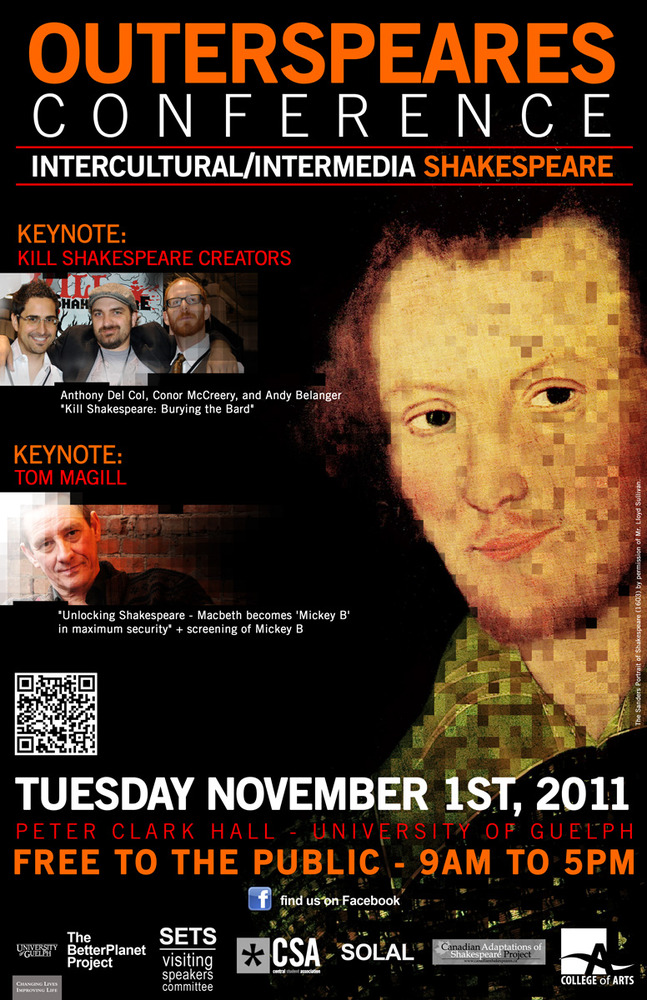
So say the organizers of a path-breaking conference taking place at the University of Guelph this November. “Outerspeares: Transcultural / Transmedia Adaptations of Shakespeare” is the first Annual Conference of the Guelph Early Modern Society, a collaboration between students and faculty in the School of English and Theatre Studies at the University of Guelph.
Arguing that our globalized, digitized media environment has truly become, in Shakespearean terms, a “brave new world,” the conference aims to show how new media are changing the way we understand Shakespeare and, in the process, are transforming our understandings of history, culture, and media itself.
The keynote speakers for the conference include Anthony Del Col, Connor McCreery, and graphic novel artist Andy Belanger, co-creators of the Kill Shakespeare graphic novel series, which is soon to be adapted into a major motion picture, and Tom Magill, director of “Mickey B,” an adaptation of Macbeth whose cast is made up of prison inmates from Northern Ireland’s notorious Maghaberry Prison.
Magill’s work as both a dramaturge who has worked extensively with Augusto Boal and as a prisoners’ rights advocate and arts educator can be viewed in the short clip below. The clip addresses the question “Can prisoners become positive role models for youth at risk?” and was filmed at a public debate on this question held at Newtownabbey just outside of Belfast (a debate marking the launch of the educational pack associated with Mickey B in 2011).
Other talks consider diverse topics such as Shakespeare on Facebook, Shakespeare in film after 9/11, YouTube culture, Iranian adaptations, and much more.
The Outerspeares Conference is being produced in collaboration with the School of English and Theatre Studies, the SETS Visiting Speaker’s Committee, the Guelph Central Student Association, the School of Languages and Literatures, the College of Arts, and the Canadian Adaptations of Shakespeare Project (CASP) directed by Dr. Daniel Fischlin.
The conference is free to the public and to the university community at large, and will take place at Peter Clark Hall in the University Centre on November 1 from 9:00 AM to 5:30 PM. Contact the Guelph Early Modern Society for more details.
For a review of the conference published in The Ontarion click here. For the CFRU FM review of the conference (“Outerspeares Conference Shakes Up Early Modern Studies”) click here.
In 2011 CASP Research Associate Lynne Bradley performed an extended “killer” interview with the Canadian creators of Kill Shakespeare, a 12-book graphic novel series soon to be a film. CASP is pleased to publish this revealing interview with Anthony Del Col and Conor McCreery in full, along with a provocative critical introduction by Bradley, and a new trailer of the film.
Kill Shakespeare …
An epic adventure that will change the way you look at Shakespeare forever.
In this dark tale, the Bard’s most famous heroes embark upon a journey to discover a long-lost soul. Hamlet, Juliet, Othello, Falstaff, Romeo and Puck search for a reclusive wizard who may have the ability to assist them in their battle against the evil forces led by the villains Richard III, Lady Macbeth and Iago. That reclusive wizard? William Shakespeare. (from the Kill Shakespeare website)
CASP is pleased to make available the full 1916 version of Hamlet, An Ideal Prince and Other Essays in Shakespearean Interpretation, which represents the earliest known extended Canadian critical scholarship on Hamlet and indeed Shakespeare, by the University of Manitoba Professor of English Alexander Wellington Crawford. Crawford was distinguished for also offering a course in Canadian poetry at the University of Manitoba in 1919-20 (this at a time when English Literature courses in Canadian literature were rare), and has been recognized as a pioneer in the early teaching of Canadian literature. In 1909 the Departments of Electrical Engineering, English, Political Economy, and History were established at the University of Manitoba. E.P. Fetherstonhaugh, Alexander W. Crawford, A.B. Clark, and Chester Martin were appointed as Chairs of these new departments.
Crawford, in addition to publishing Shakespeare criticism, published The Philosophy of F. H. Jacobi in 1905. He received his M.A. from the University of Toronto and his PhD at Cornell in 1902 working with Hiram Corson (1828-1911), who had published An Introduction to the Study of Shakespeare in 1889. Both works taken together, and made available for the first time as a pair, show the evolution of early Shakespearean criticism in the late-nineteenth and early-twentieth centuries in the U.S. and Canada. It is not surprising that there are pedagogical connections between the scholars producing this early criticism.
Click here to access links to the books on the CASP Essays, Documents, and Books site or click on the hyperlinked titles below to access each work.
The Sanders Portrait of Shakespeare is the only portrait of Shakespeare to have undergone as thorough and as comprehensive a level of scientific scrutiny and testing as it has received.
Below we list, in chronological order, the thirteen scientific tests that have been carried out on the Sanders Portrait, the details of the tests’ outcomes, and implications of these tests for understanding the Sanders Portrait as the only image of Shakespeare painted during his lifetime to have survived to the present.
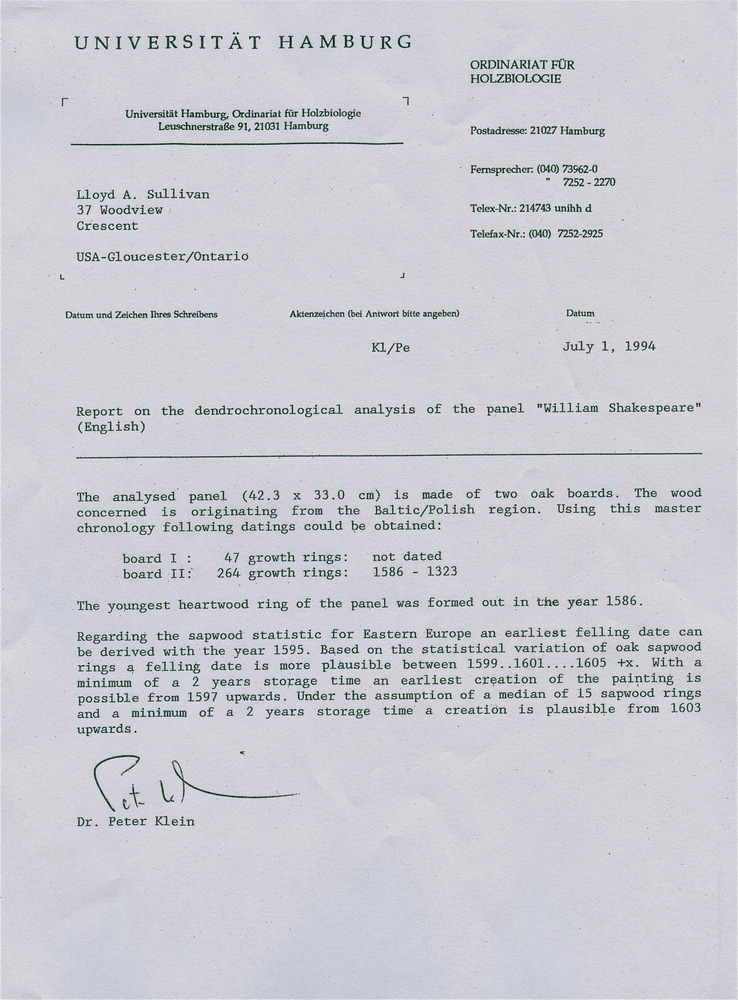
1. The first step was to authenticate the age of the portrait and then to determine if it had been altered in any way. This process began with world-renowned German dendrochronologist Peter Klein at the Hamburg University Ordinariat für Holzbiologie whose work in 1994 confirmed that the wood panels on which the portrait was painted were dated in a way wholly consistent with the 1603 date painted in red on the upper right-hand corner of the front of the portrait.
Dendrochronology is a discipline of the biological sciences that makes it possible to determine the age of wooden objects. Dendrochronological analyses are used in art history as an important means of dating wooden panels, sculptures and musical instruments. This method of dating allows dendrochronologists to ascertain at least a ‘terminus post quem’ for an art-object by determining the felling date of the tree from which the object was cut, in other words the data after which the wood for the object could have been sawn.
The method involves measuring the width of the annual rings on the panels and comparing the growth ring curve resulting from this measurement with dated master chronologies. Since the characteristics of the growth ring curve over several centuries are unique and specific to wood of differing geographical origins of wood, it is possible to obtain a relatively precise dating of art-objects. Since dendrochronology is year-specific it is more accurate than other scientific methods. But like other methods it has limitations. The method is limited only to trees from temperate zones. And even among these, some woods are better than others. A dating is possible for oak, beech, fir, pine and spruce. Linden and poplar are not datable.
Dr. Marie-Claude Corbeil Senior Conservation Scientist at the Analytical Research Laboratory of the Canadian Conservation Institute (Department of Canadian Heritage) summarizes the initial decision to proceed to dendrochronological analysis and the outcome of Dr. Klein’s research: “The first test suggested to the owner of the painting was tree-ring dating of the wood panel. By measuring the distance between growth rings and comparing this data to reference curves, it is possible to determine when a tree was cut, which will in turn provide an earliest possible date for the painting on that wood panel. For example, the portrait could not have been painted in 1603 if the wood on which it was executed was not cut until 1850. The tree-ring dating was done by an expert in the field — Peter Klein from Hamburg University. His analysis showed that the wood was oak from the Baltic region, that the earliest possible date for the execution of the painting was 1597, and that a date of execution from 1603 onward was plausible” (The Scientific Examination of the Sanders Portrait of William Shakespeare).
Click on the gallery below to access the Report from Dr. Peter Klein, which states unequivocally that “an earliest creation of the painting is possible from 1597 upwards” and that “a creation is plausible from 1603 upwards” for the Sanders Portrait of Shakespeare.
2. Once it was clear that the actual wood on which the painting was painted fit the 1603 timeline (and that this test had been conducted by an leading and independent expert in the field), the Sanders Portrait was sent to the highly respected Canadian Conservation Institute (CCI) under the direction of the aforementioned Dr. Marie-Claude Corbeil in Ottawa.
Through conservation science, treatment, and preventive conservation, the Canadian Conservation Institute supports the heritage community in preserving Canada’s heritage collections so they can be accessed by current and future generations. This mission is accomplished through conservation research and development, expert services, and knowledge dissemination.
The CCI undertook several years of scientific testing and examination. They conducted twelve separate tests using multiple and sophisitcated techniques that confirmed that the portrait was indeed painted in the early 1600s and that the materials were consistent with those available at that time.The tests further showed that no alterations or over-painting had occurred over the portrait’s long life.
The Sanders Portrait, it should be noted, has never been cleaned or had any of its surfaces altered in any way precisely in order to preserve it in as close to its original state as possible pending the outcome of the scientific research on the portrait.
Some of the tests required further outsourcing to specific experts, thus the carbon dating tests requested by the CCI were carried out by Dr. R. P. Beukens of the IsoTrace Radiocarbon Laboratory (Accelerator Mass Spectrometry Facility) at the University of Toronto. Click on the gallery below to access Dr. Beukens’ report:
This slideshow requires JavaScript.
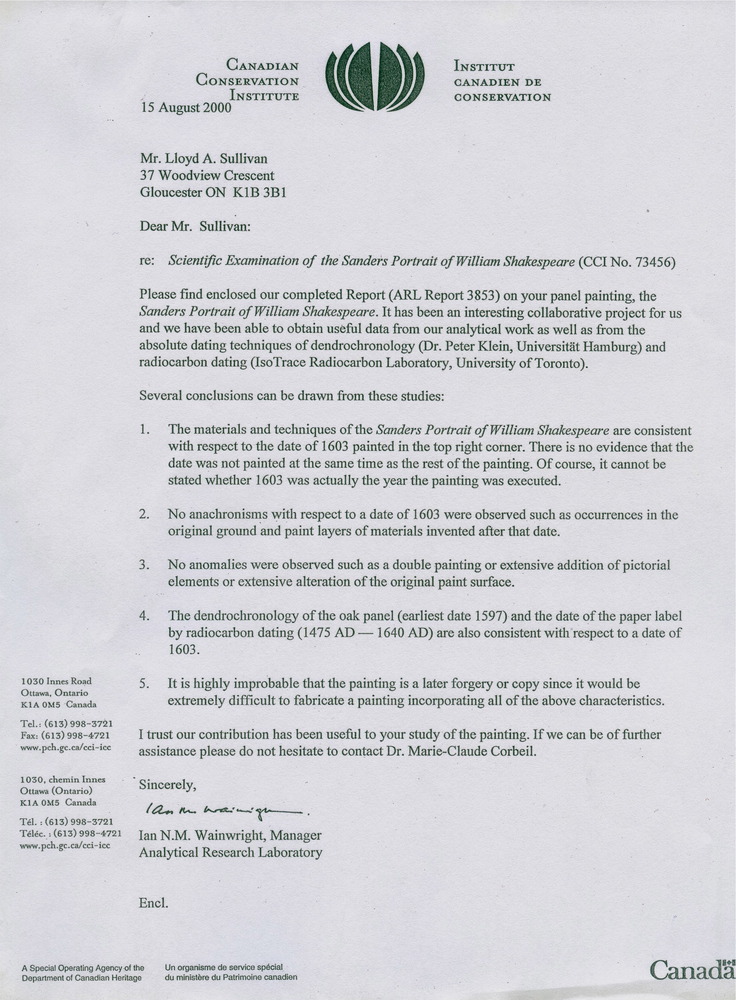
Click on the gallery below to access the covering letter and summary of the research conducted by the CCI on the portrait by Ian N. M. Wainwright, the Manager of the Analytical Research Laboratory at the CCI:
Wainwright’s summary explicitly states that the “materials and techniques of the Sanders Portrait of William Shakespeare are consistent with respect to the date of 1603″ and that “no anachronisms with respect to the date of 1603 were observed.” Further, the CCI summary notes that “no anomalies were observed such as double painting or extensive addition of pictorial elements or extensive alteration of the original paint surface.” Wainwright concludes that “it is highly improbable that the painting is a later forgery or copy since it would be extremely difficult to fabricate a painting incorporating all of the above characteristics.”
The CCI science documenting the portrait includes ultraviolet-induced-colour fluorence photography; infrared photography; and infrared reflectography.
The label glued to the back of the panel was documented using infrared photography; infrared reflectography; and digital processing in an attempt to enhance the visibility of the writing on the label (extremely faded due to age and the materials used).
Several areas of the painting were analyzed non-destructively using radioisotope-excited x-ray energy spectrometry (REXES) using an americium-241 radioisotope.
Microscopic paint samples were taken and were analyzed using the following techniques: scanning electron microscopy/x-ray energy spectrometry (SEM/XES); x-ray diffraction (XRD); fourier transform infrared (FTIR) spectroscopy; and polarized light microscopy (PLM).
Two samples were prepared as cross-sections by embedding them in polyester resin and preparing them using standard grinding and polishing techniques. These cross-sections were examined using: light and fluorescence microscopy anlayzed by SEM/XES; staining tests were done on the cross-sections with amido black, a stain used for protein.
The paper of the label was analyzed by FTIR spectroscopy and examined by light microscopy; a sample of the paper was submitted to the IsoTrace Radiocarbon Laboratory at the University of Toronto (see full report above) for radiocarbon dating; and finally, the wood was examined using dendrochronological techniques.
When biologist Gregory Young examined the label on the back of the Sanders Portrait of Shakespeare under an optical microscope he identified it as made from linen rag, a type of paper common in 1603 (tree pulp is used to make most modern paper).
Chemist Elizabeth Moffatt studied the glue used to affix the label to the oak panel using infrared spectroscopy. Typically, when a substance absorbs infrared radiation, the bonds between its atoms vibrate with a characteristic frequency, and a characteristic spectrum is produced. Moffat identified a spectrum that indicated the glue was made from a plant starch (likely rice or potatoes), a finding wholly consistent with the 1603 date––polymer adhesives did not come into use until the beginning of the last century (from Stephanie Nolen’s account of the CCI testing in Shakespeare’s Face, p. 206).
None of these tests or techniques revealed any inconsistencies in any physical aspect of the Sanders Portrait. No other portrait associated with Shakespeare has had anywhere near this degree of thorough scrutiny by some of the most eminent scientific experts in this field in the world.
Click on the image below to access the full CCI report:
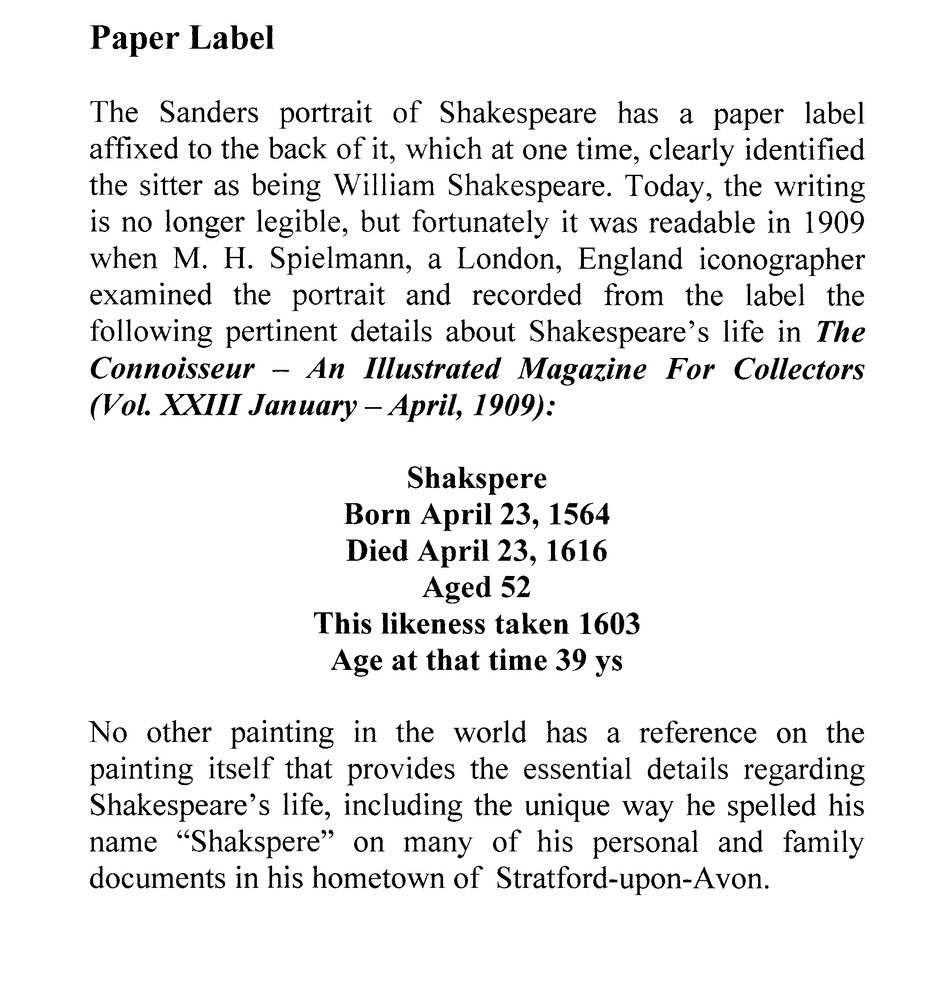
3. Finally, in 2007, a final (thirteenth test) was carried out on the only remaining physical aspect of the portrait that had not been tested––the ink used to write on the label affixed to the back of the portrait. Click on the image below to see what is written on the label and why this is of importance:
McCrone Associates, Inc. of Chicago, Illinois, are the leading forensic ink experts in the world, having successfully carried out tests on the Shroud of Turin, the Vineland map, the Gospel of Judas and now the Sanders portrait of Shakespeare.
McCrone Associates took small samples of the ink using an extremely fine-pointed tungsten needle. They tested these samples using polarized light microscopy (PLM), infrared spectroscopic analysis, and scanning electron microscopy and elemental analysis. The tests revealed that the likely ink used was iron gall and that the fading of the writing on the label is wholly consistent with the behaviour of iron gall inks over time (in 1909 Dr. M. H. Spielmann was able to read and transcribe the writing on the label––today it is almost illegible).
Joseph G. Barabe, Senior Research Microscopist and Director of Scientific Imaging at McCrone Associates concludes that “the ink formulation [on the label of the Sanders Portrait] appears to be consistent with materials and manufacturing methods … established for the label by carbon dating analysis at the University of Toronto (p. 10; McCrone Report dated 11 September 2007).
This conclusion was reviewed by Dr. Marie-Claude Corbeil at the CCI who agreed that “The ink formulation appears to be consistent with materials and manufacturing methods available during the time interval established for the paper [of the label] based on radiocarbon dating, i.e. circa 1627-1667” (email correspondence with Lloyd Sullivan 28 September 2007). This conclusion suggests that the painter (or the owner of the painting) decided to affix the label sometime after Shakespeare’s death and would have been close enough to the Shakespeare family to know the birth and death details, details that were not made public for almost 150 years after Shakespeare died.
McCrone’s tests prove conclusively that the ink on the paper label on the back of the Sanders portrait is consistent with the early to mid-seventeenth century dating of the label, the date established for the label by carbon-dating analysis at the IsoTrace Radiocarbon Laboratory at the University of Toronto.
The ink test marks the thirteenth and final test carried out on the Sanders Portrait of Shakespeare. With this last test, all physical components of the the Sanders Portrait have been independently tested with none of the tests showing any anomaly of any sort that is inconsistent with the Sanders family claims of this being an authentic and true image of Shakespeare painted during his lifetime by a family member.
CASP is pleased to make available Canadian documentarian Anne Henderson‘s extended interview (April 22, 2010) with the well-known National Public Radio (NPR) broadcaster Bob Edwards. The interview, which took place in Washington D.C. prior to a screening of the film at the Smithsonian, addresses many of the circumstances surrounding the research conducted on the Sanders Portrait of Shakespeare. These have changed in the year since the interview took place as a result of major progress made on the genealogy of the Sanders family.
Click below to listen to the interview in its entirety.


 “I wanted to create a unique teaching and learning tool that appeals to the tech-savvy among us, and I’m relieved that the app passed Apple’s rigorous review process,” Fischlin said. “I’m also keenly aware of how much more there is to do in terms of making it accessible on other software platforms.”

 Canadian Shakespeare News
You must be logged in to post a comment.